In the old days, people did not understand how the heart functioned. Even without this knowledge, people tried to save those whose breathing had stopped. Although they lacked scientific understanding, they still believed that life could be restored in some cases. Because of this belief, people used their available tools and ideas to save lives.
The first techniques used to save people whose breathing had stopped were very unusual. For example, some used the “Heat Method,” which involved applying hot coals or warm ashes directly to a victim’s skin to shock the body back to life. Others tried the “Fumigation Method,” where they blew tobacco smoke into the victim’s body because they believed the warmth and nicotine would stimulate the heart. They truly believed that people could be brought back to life using these techniques. Apart from that, different groups tried various ways to restore breathing, such as rolling victims over large barrels or even hanging them upside down.
Unfortunately, these methods often caused more harm than good. The “Heat Method” frequently resulted in severe burns, while the “Fumigation Method” could cause internal damage. Over time, rescuers noticed that victims rarely woke up after these treatments. In many cases, the methods actually made the victim’s condition worse. People eventually realized these ideas did not work because the results were not consistent, and the injuries to the survivors were too great to ignore.
However, in the Middle Ages, people used even stranger techniques to save people whose breathing had stopped. For instance, people used a technique called flagellation, which meant hitting people whose breathing had stopped using whips. Another common practice was the “Inversion Method,” where victims were hung by their feet. People believed that gravity would help drain fluids and “shake” the life back into the body.
Similar to the earlier methods, these techniques were often painful and dangerous. Flagellation caused external injuries, and hanging people upside down could lead to further respiratory failure. Rescuers eventually noticed that these methods did not increase survival rates. Instead of helping, these actions often caused unnecessary suffering for the victims. Through observation, early medical thinkers realized that “waking up” the body through pain or gravity was not the answer to restoring breath.
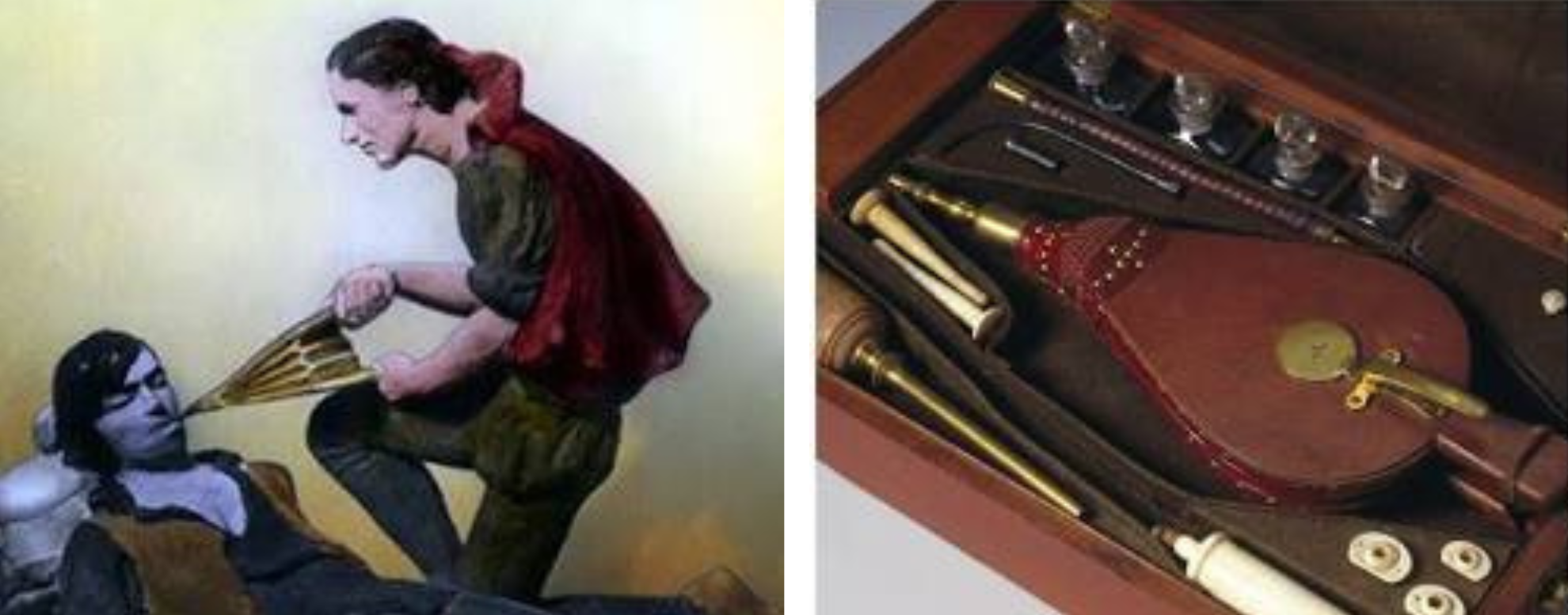
After that, new ideas began to emerge. In the 1700s, doctors began experimenting with air and breathing. For instance, doctors began using a device called a bellows. Normally, a bellows is used to blow air into a fireplace. However, doctors began using a bellows to blow air into a person’s lungs. At that time, this was a very promising idea.
In addition to bellows, doctors tried using long wooden tubes or silver pipes. They would insert these into the victim’s throat to create a direct path for air. Some societies even created a “Drowning Screen,” which was a large board used to push and pull on the victim’s chest while air was being forced in. These tools were used to manually inflate and deflate the lungs like a balloon.
Today we know that using bellows was often dangerous because the pressure could be too high for human lungs. However, this period was important for one reason. Scientists began to realize that lungs required a specific volume of air and that “stale” air was different from “fresh” air. This led to the discovery of oxygen and the understanding that breathing for someone else could keep their brain and heart alive. Driven by these early concepts, doctors began to move away from painful “shocks” and toward the scientific study of the respiratory system.
This era was the true beginning of rescue breathing. While it was only one half of the puzzle, it was a vital discovery. These early attempts at artificial ventilation paved the way for the development of full CPR, which would eventually save millions of lives.
Sources:
- The American Heart Association: History of CPR
- Museum of Bernoulli: Early Respiratory Devices
- Journal of Emergency Medicine: Evolution of Resuscitation
RESQ Arise | CPR, First Aid & BLS Training in Central Indiana